

“A fast-growing crop that gives rise to diverse products and inspires the future of production…”
Industrial hemp is one of the notable crops in sustainable agriculture thanks to its rapid growth, its ability to provide renewable raw materials, and the potential to utilize its different parts. Its journey from the field to food, textiles, and building materials offers many opportunities to make more efficient use of natural resources.
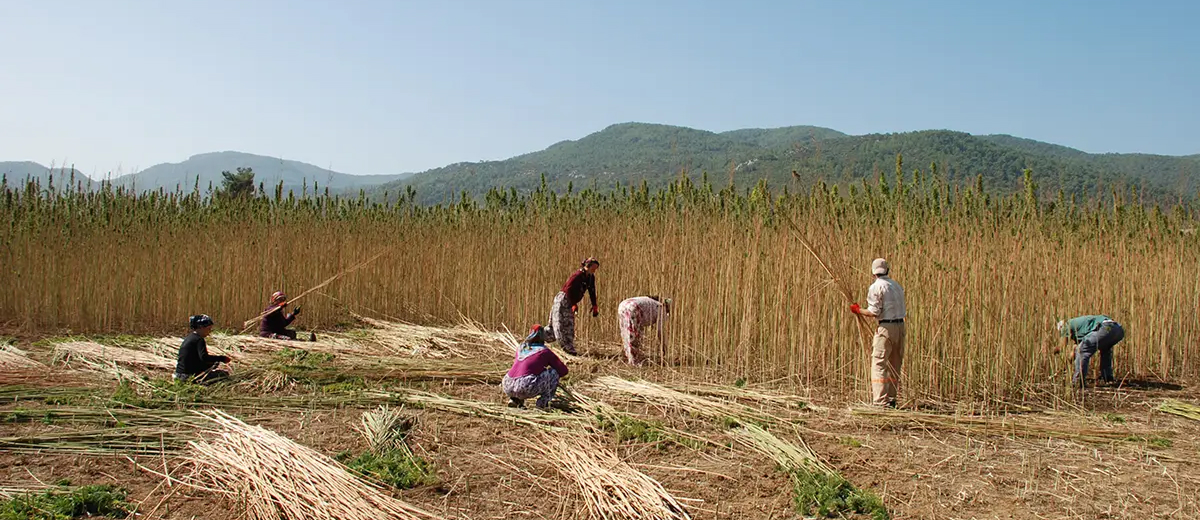
Captures Carbon as It Grows
During its growth period, hemp absorbs carbon dioxide from the atmosphere through photosynthesis and stores carbon in its plant biomass. Thanks to its rapid growth, it can produce a significant amount of biomass in a relatively short time. Some of this carbon can remain stored throughout the service life of long-lasting products such as hemp-based building materials.
A Renewable Raw Material in a Single Season
Hemp is an annual crop capable of providing both fiber and seed within a single growing season. In some varieties, fiber can be harvested in approximately 60–90 days, while seed harvest can take place within 90–120 days. This rapid production cycle makes hemp a versatile raw material that can be cultivated again each year.
A Strong Alternative for Water Efficiency
Comparative studies on fiber production indicate that hemp can require less water and have a lower water footprint than cotton. This characteristic makes hemp a valuable alternative in agricultural and textile applications focused on the efficient use of water resources. Irrigation planning suited to local rainfall and soil conditions helps translate this advantage into practice in the field.
Natural Competition with Weeds
Hemp grows rapidly and forms a dense canopy that shades the soil and suppresses weed growth. Particularly in densely planted fiber hemp, this characteristic can make weed management easier and help reduce the need for herbicides.
Covers the Soil and Adds Diversity to Crop Rotation
Hemp’s developing canopy helps protect the soil surface, reduce surface water loss, and limit erosion. Rotating hemp with different crops also adds diversity to crop rotation, supporting agricultural practices that take soil health into consideration.
Many Products from a Single Crop
Hemp seeds can be used for food and oil, its fibers for fabrics and composite materials, and the woody core of its stalk for insulation products and animal bedding. The press cake remaining after oil production can also be utilized as a raw material for different products.
Making use of different parts of the same plant creates new applications for production by-products. In this way, hemp contributes to a circular production approach aimed at reducing waste and keeping raw materials in use for longer.
Head Office: Akdeniz Mah. Cumhuriyet Bulvarı No: 120
Konak, İzmir, TURKEY 35210
Production Facility: Narlıdere – İzmir
+90 232 700 18 24
info@www.powerseed.com.tr
© 2026 YELBİS. All rights reserved.
Powerseed and AsaBotanica are brands developed by YELBİS.